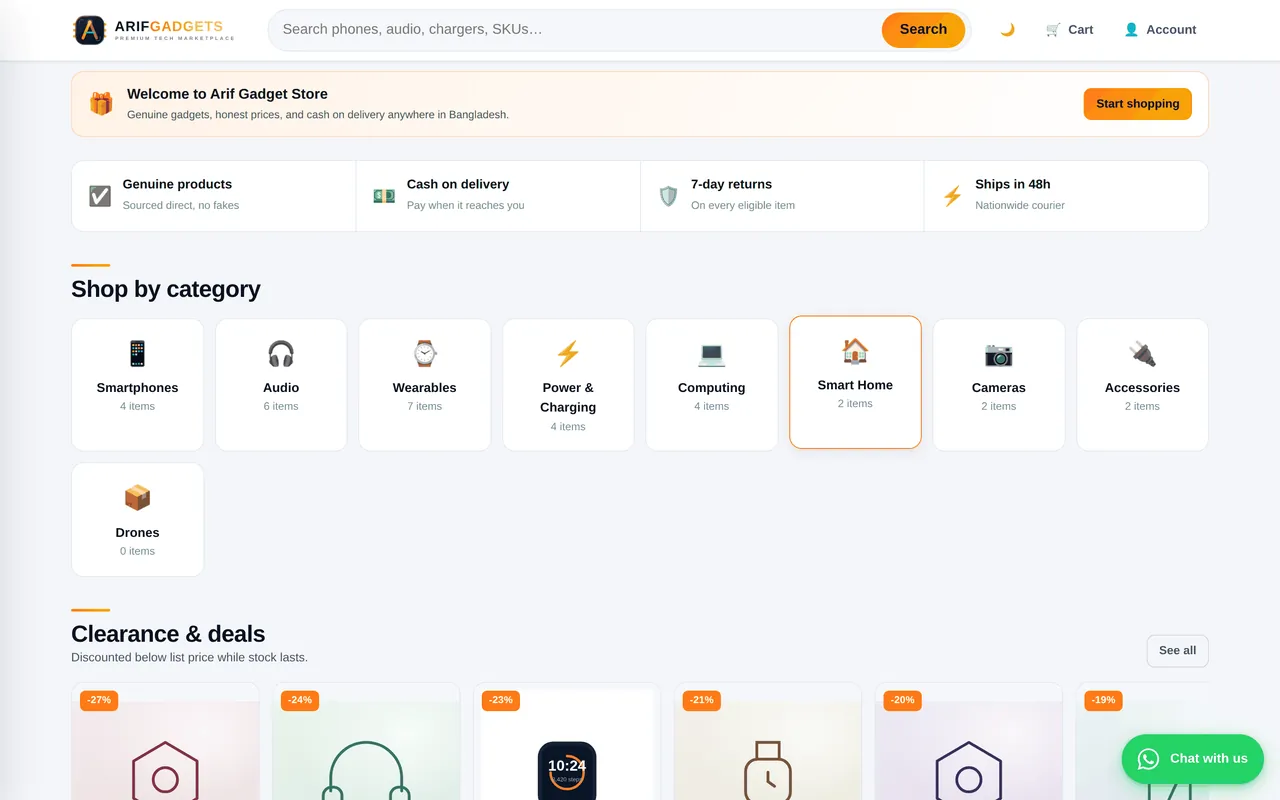
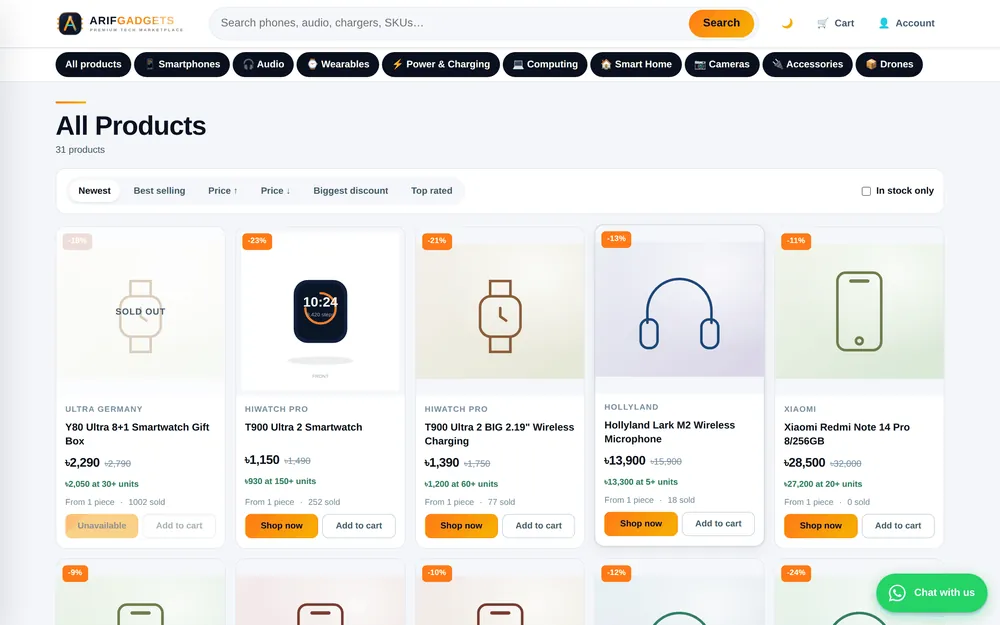
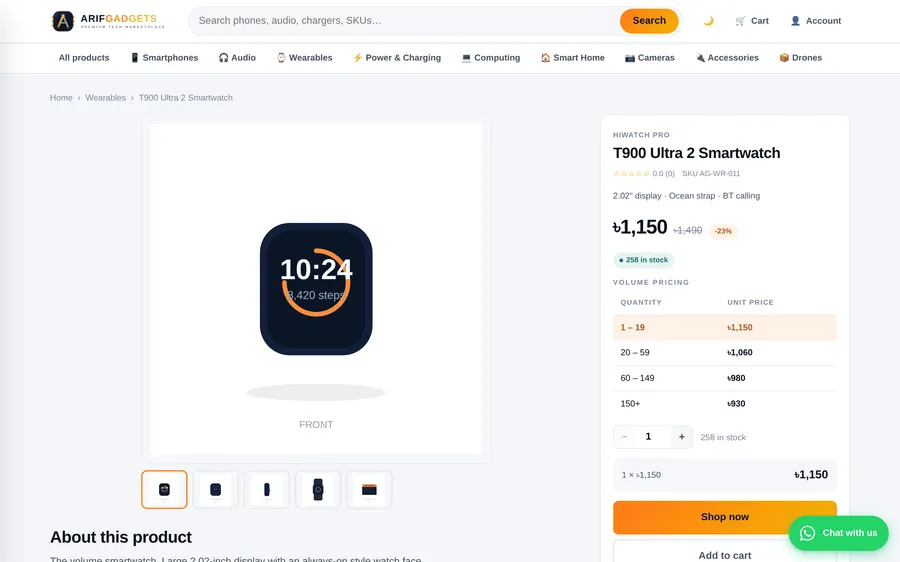
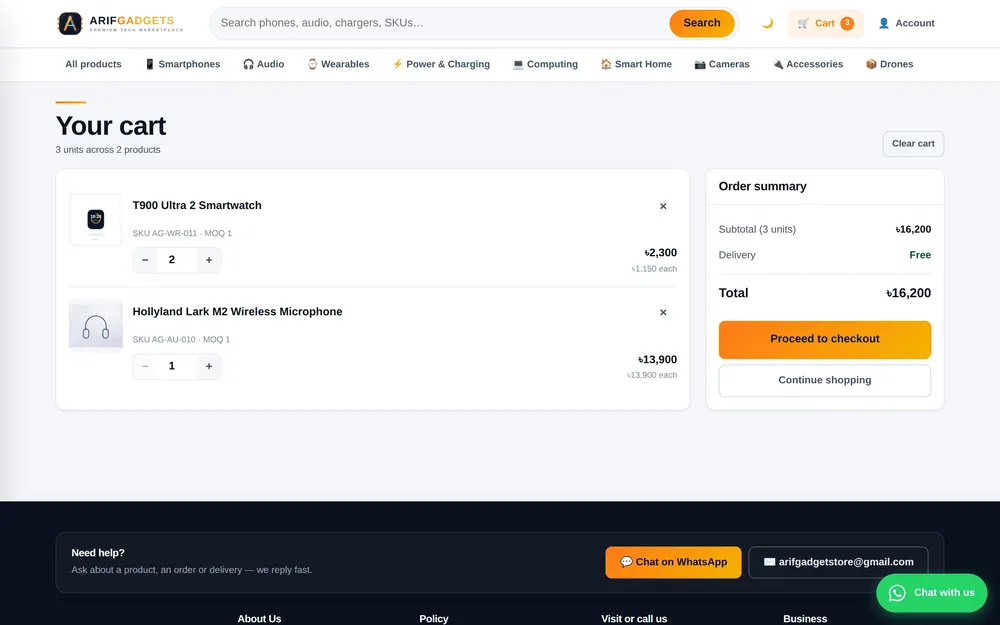
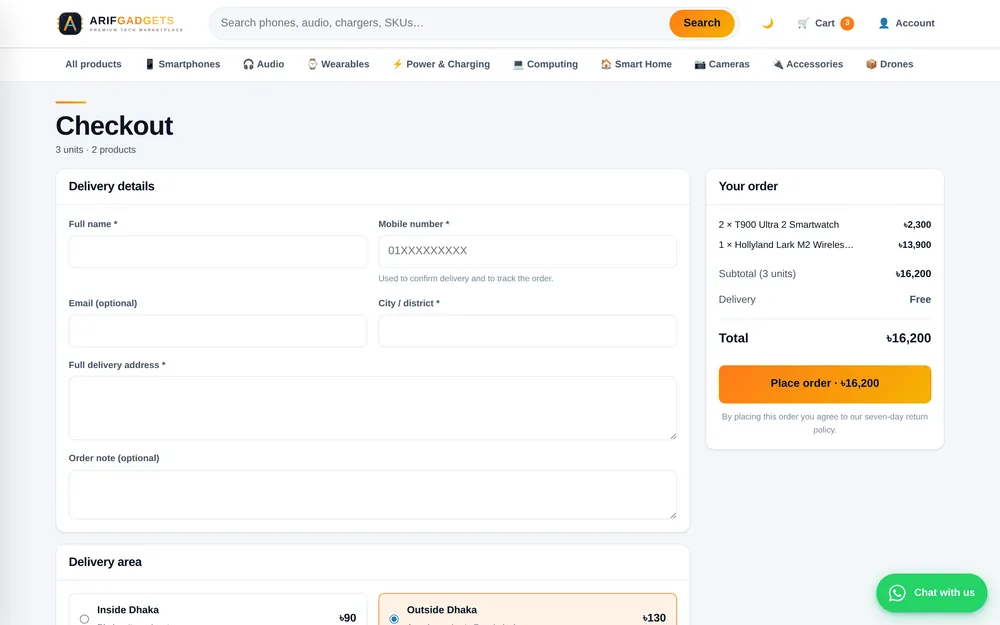
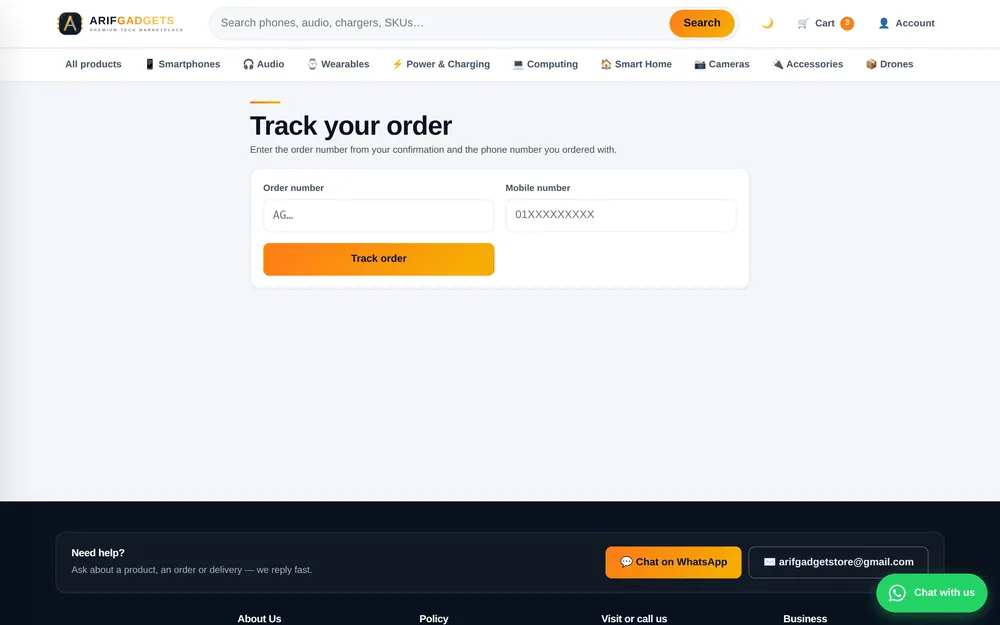
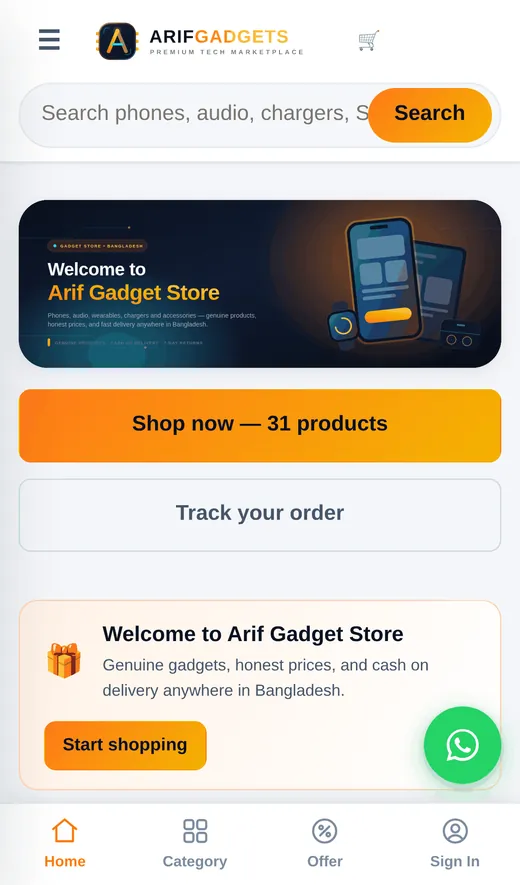
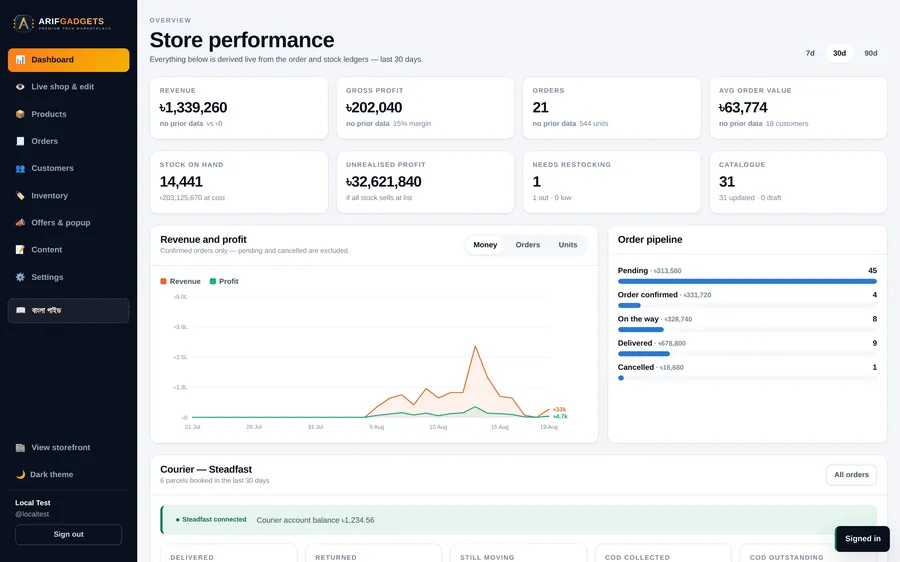
Storefront, checkout, order tracking, and the dashboard you run it from. Whatever you sell — gadgets, beauty, clothing, food, anything — the shop is built around your products, your delivery, your prices.
Free quote. Nothing to pay until the scope is agreed in writing.
These are working builds, not screenshots and not a slide deck. Open a storefront, put something in the bag, then open the dashboard behind it. Nothing you click changes anything, and every figure in them is demo data.
A full beauty and skincare shop — catalogue, cart, checkout, order tracking, customer accounts and printable invoices. Twelve screens.
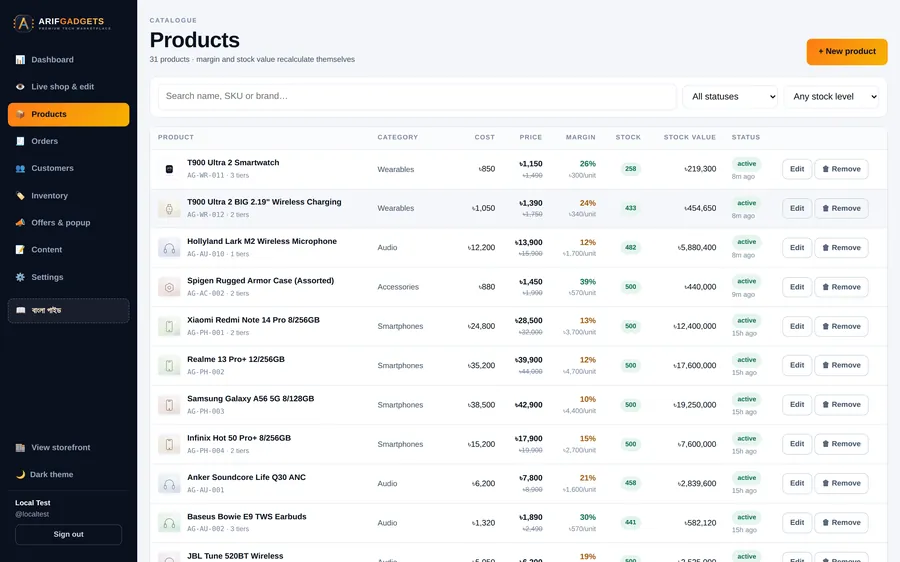
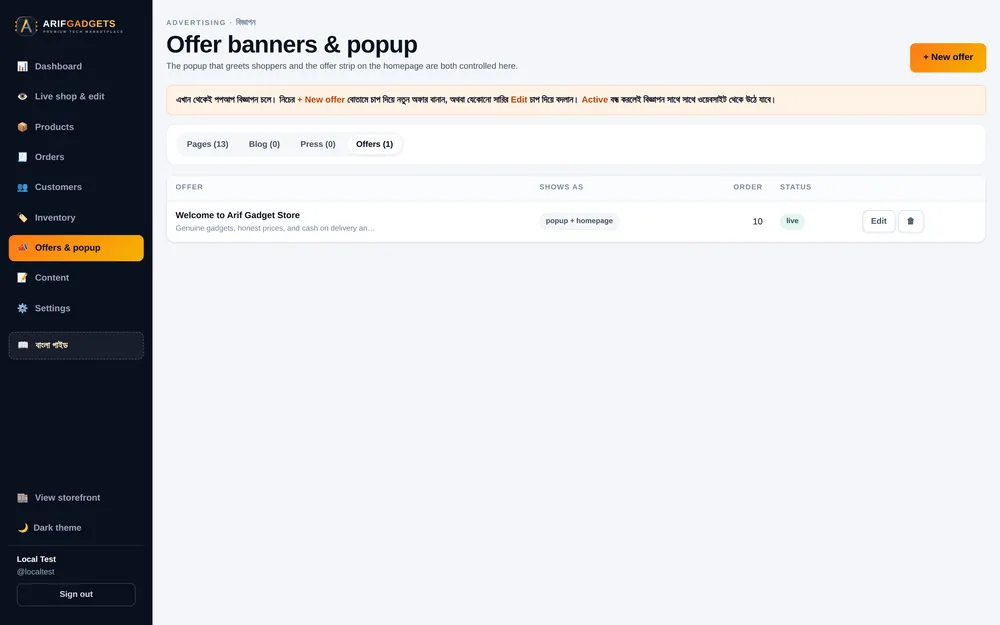
Open the demo → Admin dashboardThe back office of a working shop: orders, delivery pipeline, stock, returns, reviews, offers, staff roles, POS and barcode printing.
Open the demo → Commerce platformCatalogue, customers, campaign builder and analytics behind one navigation — the shape of tool you need once spreadsheets stop scaling.
Open the demo → All stylesEvery live demo in one place, in different styles. Find the one closest to what you want and I will build yours around it.
Browse them all →Follow one customer all the way through — arriving, browsing, ordering, tracking the parcel — then see what the owner sees on the other side.
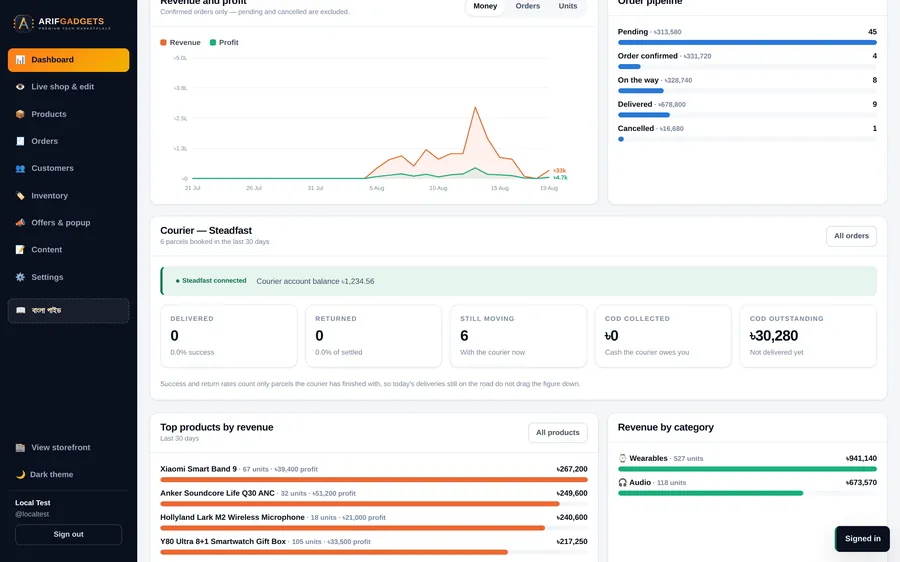
About the figures in these screenshots: they were produced by placing real orders through the live pricing engine on a demonstration dataset and letting the database do its work. They are the system’s own calculations, captured from a running browser — not a client’s private trading figures.
An order placed on the storefront, appearing in the dashboard with the profit already calculated. No narration needed — watch what happens after someone presses Buy.
No video uploaded yet. Upload one from the admin dashboard — Landing page → Offer video — and it appears here, with the scroll-in player, without touching any code.
Until then this section shows the text above, which is why the page never has a hole in it.
Not a brochure site with a contact form. A shop that sells, books the parcel, and tells you what you earned.
Categories, filters, product pages with real photographs, a bag, and a checkout with cash on delivery as the default — because that is how your customers pay.
Your customer checks their parcel with an order number. No account to create, no password to forget, no message in your inbox asking where it is.
Cost price is stored beside sale price, so margin is calculated per product and rolled up across the shop — not guessed at the end of the month.
Book the parcel from the same screen as the order, and what came back — delivered, returned, COD collected, COD outstanding — lands on the same panel.
Your buyers arrive from a Facebook ad, on a mid-range Android, over mobile data. The phone layout is designed first; desktop follows from it.
Meta Pixel in the browser and the Conversions API server-side, sharing one event ID so Meta counts each sale once. Ad-blockers stop the first; nothing stops the second.
Every package below is a starting point, not a fixed box. Tell me what you sell and the scope is shaped around it before a price is agreed.
For getting off a Facebook page and onto a real shop that takes orders on its own.
For a shop already taking orders that needs to know whether it is making money.
For running the whole business — online orders and the counter — on one system.
Nothing here is a fixed box. Any package can be customised, and if what you need is not on any of these lists, it can still be built — I build ecommerce websites to whatever the requirement is, not from a catalogue of pre-made products.
Tell me what you sell, how you deliver it, and who will run the dashboard. The scope and a fixed price come back in writing before anything is charged, and nothing is invoiced before you agree to it.
Six stages. You are involved in three and free during the other three. Nothing is invoiced before the scope is agreed in writing.
A short conversation — what you sell, who buys it, how they pay, who will run the dashboard. It ends with a written scope and a fixed price. No open-ended hourly billing.
You + me · day 1Colours, type, spacing and one signature interaction decided before any screen is laid out. That is why new pages stay consistent later without re-briefing anyone.
Me · days 2–4Storefront, dashboard and API in one repository on Cloudflare. Loads fast on mobile data in Bangladesh, and at your volume it sits inside the free tiers.
Me · the main stretchPixel plus Conversions API with shared event IDs, courier API for booking, payment instructions, order tracking. Tested in Meta's own tool before launch, not after.
Me · before handoverYou place a real order, your staff ring up a real sale, and we fix what feels wrong while it is still cheap to fix. Revisions at this stage are included.
You + me · launch weekDomain, hosting, repository and every account transferred to you, plus the Bangla staff guide. You are never locked out of your own shop, and never locked to me.
Yours · from then onNot a sales call you have to sit through. You describe what you sell, and you get back exactly what would be built, what it costs, and how long it takes — in writing, free, with nothing to pay to see it.
Usually answered within one working day, in Bangla or English — whichever you prefer.
Answer these and a scope and fixed price come back, usually within one working day. No call needed first, and nothing is charged for the quote.
Your details go to one inbox — mine. Not sold, not shared with a third party, not added to any mailing list.
A working shop: your catalogue, product pages, a bag, a checkout that takes cash-on-delivery orders, and order tracking by number — built mobile-first with the Meta Pixel wired in. It is the shop, not the back office. The dashboard with revenue and profit is the next package up, and you can move up to it later without rebuilding what you already paid for.
Yes — that is the normal case, not the exception. The packages are starting points so you have a number in your head before we speak. Describe what you need in the form and the scope gets shaped around your requirement, with the price agreed in writing before anything starts.
A Starter shop is usually one to two weeks. A complete build is three to six, depending mostly on how fast product photos and cost prices come back from your side. That dependency is named in the scope, so it is not a surprise halfway through.
At the volume of a shop like the ones in the demos, effectively nothing — it sits inside Cloudflare's free tiers. The real bill is your domain, roughly ৳1,200 a year. If you outgrow the free tiers that is a good problem, and I will tell you before it happens rather than after.
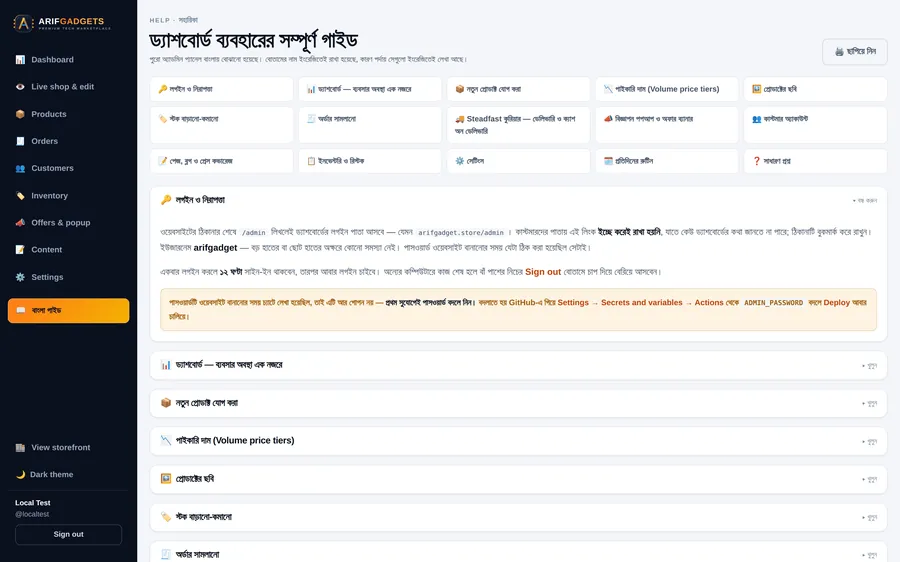
That is what the Bangla guide is for, and why staff roles exist — a salesperson sees orders and stock, not your profit margins. The dashboards in the demos are run daily by people who had never used an admin panel before.
Yes, and this is the part most builds get wrong. The Pixel alone loses a real share of mobile traffic to ad-blockers and iPhone privacy settings. Every build here also sends events server-side through the Conversions API with a shared event ID, so Meta counts each sale once and still sees the ones the browser copy lost.
Then you leave with everything. The code is in your repository, the domain and hosting are in your name, and the stack is standard TypeScript any competent developer can pick up. There is no proprietary layer holding you here.
Yes. The defaults on this page — cash on delivery, local couriers, a Bangla staff guide — are what Bangladeshi shops need. If you are elsewhere, those are swapped for what your market uses. Say where you are in the form.